
Automated vs Manual Bidding in Google Ads: Which Should You Choose?
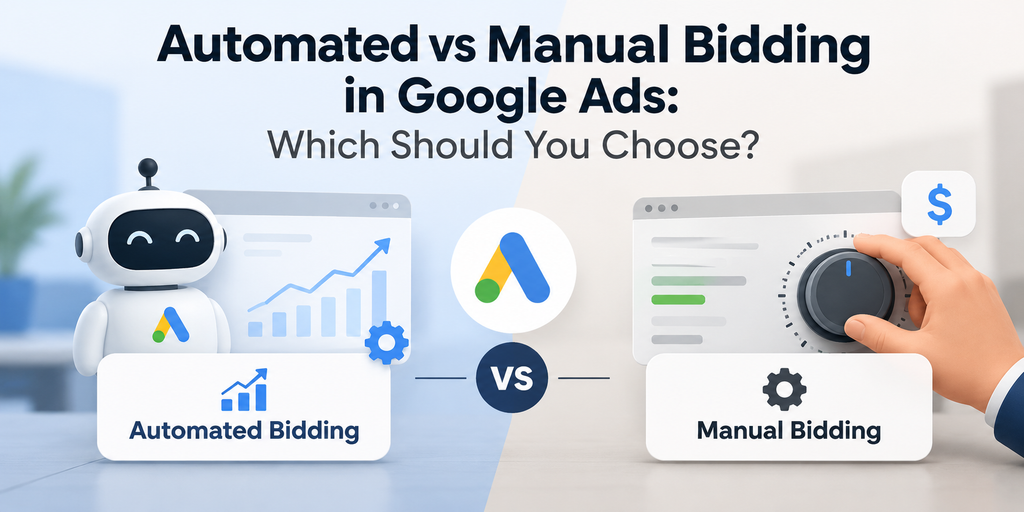
A practical guide to picking the right bidding approach for your campaigns.
Every Google Ads account owner eventually faces the same question: should I let Google’s algorithms set my bids, or keep my hands on the wheel? The honest answer is that neither is always better. The right choice depends on your data, your goals and how much time you can give the account. This post breaks down how each approach works, where each one shines, and how to decide.
What is manual bidding?
With manual bidding, you set the maximum amount you’re willing to pay per click (Manual CPC). You can set bids at the ad group or keyword level and adjust them for device, location, audience or time of day.
The appeal is control. If you know a particular keyword converts well, you can bid aggressively on it. If a keyword drains budget, you can pull the bid down immediately.
Pros
- Full control over every bid
- Predictable, transparent behavior
- Works with little or no conversion data
- Useful for testing new keywords or markets
Cons
- Time-consuming, especially at scale
- Can’t react to real-time signals the way an algorithm can
- Easy to over- or under-bid based on gut feeling
- Performance depends heavily on your skill and attention
What is automated bidding?
Automated bidding, often called Smart Bidding, uses machine learning to set bids at auction time. Instead of one bid per keyword, Google evaluates signals for each individual search: device, location, time, browser, remarketing lists, query intent and many more, then predicts how likely a click is to convert.
Common strategies include:
- Maximize Conversions: gets as many conversions as possible within your budget
- Maximize Conversion Value: prioritizes higher-value conversions, ideal for ecommerce
- Target CPA: aims for a set cost per acquisition
- Target ROAS: aims for a set return on ad spend
- Maximize Clicks and Target Impression Share: traffic and visibility goals rather than conversion goals
Pros
- Optimizes in real time using far more signals than a person can process
- Saves hours of manual adjustment
- Aligns bidding directly with business goals like CPA or ROAS
- Typically improves with more data
Cons
- Needs reliable conversion tracking and enough data to learn
- Less transparency into why bids change
- A learning period can cause temporary volatility
- Bad inputs (wrong conversion actions, poor tracking) lead to bad outcomes at scale
Head-to-head comparison
| Factor | Manual bidding | Automated bidding |
|---|---|---|
| Control | High | Lower (you set goals, not bids) |
| Time required | High | Low |
| Data needed | Little | Meaningful conversion volume |
| Real-time signals | Limited | Extensive |
| Best for | New or low-volume campaigns, testing | Established campaigns with conversion data |
| Biggest risk | Human error and slow reaction | Poor tracking, black-box behavior |
When manual bidding makes sense
- Brand-new accounts or campaigns. With no conversion history, algorithms have nothing to learn from. Manual bidding lets you gather data first.
- Very low conversion volume. If you only get a handful of conversions a month, automation may struggle to find patterns.
- Tight control requirements. Some advertisers need strict caps on cost per click for specific terms.
- Experiments. Manual bids can serve as a clean baseline when you test a new strategy.
When automated bidding makes sense
- You have solid conversion tracking. This is the non-negotiable foundation.
- You have steady conversion volume. More data gives the model more to work with.
- You manage many keywords or campaigns. Automation scales in a way manual work can’t.
- You have a clear efficiency goal. If you know your target CPA or ROAS, automation is built to chase it.
The hybrid path: start manual, graduate to automated
Many successful advertisers don’t treat this as an either/or decision. A common approach looks like this:
- Launch with manual bidding or Maximize Clicks to collect traffic and conversion data.
- Make sure conversion tracking is accurate and meaningful.
- Once you have consistent conversions, switch to Maximize Conversions or Maximize Conversion Value.
- After the strategy stabilizes, add a Target CPA or Target ROAS based on what you’ve actually achieved.
One caution: don’t set aggressive targets right away. Start close to your real historical performance and tighten gradually.
Tips for getting the most out of automated bidding
- Be patient during the learning period. Avoid changing budgets, targets or strategies repeatedly in the first couple of weeks.
- Feed it quality data. Track the conversions that actually matter to your business, not every minor action.
- Set realistic budgets. A budget that’s too small limits what the algorithm can do.
- Use audience and negative keyword controls. Automation sets bids, but you still guide who it targets.
- Review results regularly. Hands-off doesn’t mean eyes-off. Check search terms, conversion quality and lead quality.
Common mistakes to avoid
- Switching to automated bidding without verifying conversion tracking
- Changing strategies too often and resetting the learning phase
- Setting a target CPA or ROAS far from realistic levels
- Judging performance after just a few days
- Ignoring lead or sales quality while chasing cheaper conversions
The bottom line
Manual bidding offers control, while automated bidding offers scale and real-time intelligence. For most established advertisers with good tracking, automated bidding will outperform manual management over time. For new campaigns or very low-volume accounts, manual bidding can be a smart starting point.
The real skill isn’t choosing a side. It’s knowing which tool fits your stage of growth, and being willing to switch when your data says it’s time.
Note: Google regularly updates its bidding options and naming, so check the current options in your Google Ads account before making changes.