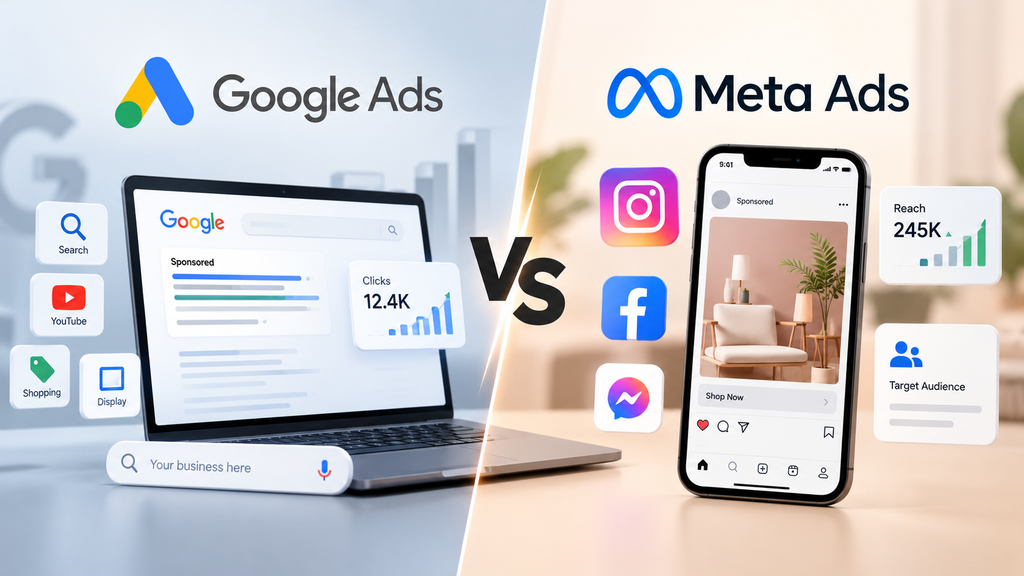
Google Ads vs Meta Ads: Which Is Better for Your Business in 2026?
Introduction
Choosing the right advertising platform is one of the most important decisions for businesses investing in digital marketing. With multiple advertising channels available, two platforms consistently stand out: Google Ads and Meta Ads.
Both platforms offer powerful advertising solutions, but they work differently. Google Ads helps businesses connect with people actively searching for products or services, while Meta Ads enables brands to reach potential customers through platforms such as Facebook and Instagram.
So, which platform should your business choose in 2026?
The answer depends on your business objectives, target audience, budget, sales cycle, and marketing strategy. In this guide, we will compare Google Ads vs Meta Ads, explore their key differences, discuss advertising costs, and explain how to choose the right platform for your business.
What Are Google Ads?
Google Ads is Google’s online advertising platform that allows businesses to promote products and services across Google Search, YouTube, Google Display Network, Google Shopping, and other eligible placements.
One of its biggest advantages is search intent. Businesses can display ads when users search for specific keywords related to their offerings.
For example, someone searching for “digital marketing agency in Dubai” may be actively looking for a marketing partner. A relevant Google Search ad can put your business in front of that potential customer.
Key Features of Google Ads
- Search advertising: Reach users searching for relevant products or services.
- Display advertising: Promote your brand through visual ads across participating websites and apps.
- YouTube advertising: Use video campaigns to build awareness and generate demand.
- Shopping advertising: Showcase eligible products with images, pricing, and product information.
- Performance Max: Use Google’s automation to reach customers across eligible Google advertising channels.
- Conversion tracking: Measure actions such as purchases, leads, calls, and form submissions when properly configured.
Benefits of Google Ads
Google Ads is particularly useful for businesses that want to capture existing demand. Since users may already be searching for a solution, the platform can help attract high-intent prospects.
Other benefits include keyword-level targeting, measurable conversion performance, flexible campaign budgets, and the ability to adjust campaigns based on business results.
However, competition for valuable keywords can be expensive. Campaigns also require relevant landing pages, appropriate keyword selection, and ongoing optimization to perform effectively.
What Are Meta Ads?
Meta Ads is the advertising platform used to create and manage paid campaigns across Meta-owned placements, including Facebook, Instagram, Messenger, and the Meta Audience Network, where eligible.
Unlike search advertising, Meta Ads primarily helps businesses reach audiences based on factors such as interests, behaviors, demographics, and signals used by Meta’s advertising systems.
Meta also supports retargeting and automated audience expansion, subject to campaign settings, data availability, and privacy requirements.
For example, a new skincare brand can use Instagram Reels and Facebook feed ads to introduce its products to potential customers who may not be actively searching for skincare products.
Key Features of Meta Ads
- Facebook advertising: Reach audiences through feed, video, Stories, and other eligible placements.
- Instagram advertising: Promote products and services through Reels, Stories, feed posts, and more.
- Audience targeting: Use available demographic, interest, custom audience, and lookalike audience options.
- Retargeting: Re-engage eligible website visitors and previous customers using available audience data.
- Creative testing: Test different videos, images, headlines, and messaging.
- Lead generation: Collect leads through instant forms or direct users to external landing pages.
- Automated campaign optimization: Use Meta’s delivery systems to optimize toward selected campaign objectives.
Benefits of Meta Ads
Meta Ads is especially valuable for businesses that rely on visual storytelling, product discovery, audience engagement, and demand generation.
Its creative formats allow businesses to demonstrate products, explain services, showcase customer experiences, and build brand familiarity before a prospect is ready to purchase.
However, reaching a large audience does not automatically translate into sales. Strong creative assets, a clear offer, an effective landing page, and a reliable conversion measurement setup are essential.
Google Ads vs Meta Ads: Key Differences
Although both platforms support performance marketing, their strengths differ significantly.
| Comparison Factor | Google Ads | Meta Ads |
|---|---|---|
| Primary strength | Capturing existing demand | Generating and nurturing demand |
| User behavior | Users may be actively searching | Users are often browsing social content |
| Targeting approach | Keywords, intent signals, audiences | Audience signals, interests, demographics, and custom audiences |
| Main ad formats | Search text ads, shopping ads, display, video | Image ads, video ads, Reels, Stories, carousels |
| Creative requirements | Strong ad copy and relevant landing pages | Strong visuals, videos, hooks, and messaging |
| Typical use cases | Local services, B2B leads, urgent needs, high-intent purchases | E-commerce, brand awareness, product discovery, lead generation |
| Retargeting | Available across eligible campaign types | Available through eligible custom audiences and placements |
| Measurement | Clicks, conversions, conversion value, and other metrics | Clicks, conversions, conversion value, engagement, and other metrics |
| Main challenge | Keyword competition and cost | Creative fatigue and converting audience interest into sales |
The most important difference is that Google Ads can help you reach people expressing intent, while Meta Ads can help you introduce an offer to people who may not yet be looking for it.
Neither platform is universally better. Performance depends on the market, campaign structure, offer, creative quality, and conversion journey.
Google Ads vs Meta Ads: Which Is More Cost-Effective?
Advertising cost is one of the biggest considerations when choosing between these platforms. However, there is no fixed rule that Google Ads is always more expensive or that Meta Ads always delivers cheaper leads.
Costs vary by industry, geography, competition, audience, campaign objective, seasonality, and campaign quality.
Understanding Google Ads Costs
Google Search campaigns commonly use a cost-per-click model, meaning advertisers pay when users click their ads under the applicable campaign pricing model.
Your cost can depend on keyword competition, expected performance, ad relevance, bidding strategy, and other auction factors.
For example, a business advertising competitive legal services or enterprise software may face higher click costs than a business targeting a less competitive niche.
Google Ads can still be profitable when the value of each qualified lead or customer justifies the advertising expense.
Understanding Meta Ads Costs
Meta Ads costs depend on factors such as campaign objective, audience competition, ad quality, placement, and bidding strategy.
Businesses often use Meta Ads to test different creative concepts and generate awareness or leads at scale. However, inexpensive clicks or leads do not necessarily mean the campaign is profitable.
For example, an online store may generate many low-cost clicks through Instagram ads, but if visitors do not purchase, the campaign may produce a poor return.
Which Platform Offers Better ROI?
The better platform is the one that generates more valuable business outcomes relative to the total cost of acquiring them.
Consider these metrics when evaluating performance:
- Cost per lead (CPL): Advertising spend divided by leads generated.
- Customer acquisition cost (CAC): Total relevant acquisition costs divided by new customers acquired.
- Conversion rate: The percentage of visitors or other eligible users who complete the desired action.
- Return on ad spend (ROAS): Attributed revenue divided by advertising spend.
- Lead quality: The percentage of generated leads that become qualified opportunities or customers.
For lead-generation businesses, a campaign generating fewer but better-qualified leads may be more profitable than one generating a high volume of low-quality enquiries.
For e-commerce brands, compare purchase value, contribution margin, returns, and customer acquisition cost rather than relying on clicks alone.
When Should You Choose Google Ads?
Google Ads is often a strong starting point when potential customers already know what they need and actively search for relevant solutions.
Consider Google Ads if your business:
1. Provides services people actively search for
Businesses such as plumbers, consultants, lawyers, clinics, and marketing agencies can benefit from reaching users searching for specific services.
2. Targets high-intent B2B leads
If decision-makers search for software, professional services, or business solutions, carefully targeted Search campaigns can help capture that demand.
3. Sells products with established search demand
Google Shopping and Search campaigns can connect eligible product offerings with shoppers who are actively researching or comparing products.
4. Wants to generate enquiries quickly
When search demand exists, relevant campaigns can start attracting potential customers as soon as ads become eligible to serve. Results and lead quality are not guaranteed.
5. Has a clearly defined conversion goal
Google Ads can work well when success can be measured through purchases, booked appointments, calls, qualified enquiries, or other meaningful actions.
When Should You Choose Meta Ads?
Meta Ads is often a strong option when your business needs to build awareness, demonstrate product value, or reach potential customers before they begin actively searching.
Consider Meta Ads if your business:
1. Sells visually appealing products
Fashion, beauty, home decor, food, lifestyle products, and similar categories can benefit from product demonstrations, creator-style videos, and engaging visual content.
2. Is launching a new brand
A new business may have limited existing search demand. Meta Ads can introduce the brand, explain its value proposition, and help identify which messages resonate with potential customers.
3. Needs to scale creative testing
Brands can test different hooks, offers, product demonstrations, and customer testimonials to understand which creative approaches produce meaningful results.
4. Wants to generate leads through social campaigns
Education providers, real estate businesses, service providers, and other eligible advertisers can use lead forms or landing pages to collect enquiries.
5. Wants to re-engage previous visitors or customers
Subject to consent, privacy requirements, audience eligibility, and available data, Meta Ads can help businesses reconnect with people who have previously interacted with their brand.
Can You Run Google Ads and Meta Ads Together?
Yes. In many cases, combining Google Ads and Meta Ads creates a more complete customer acquisition strategy.
Instead of treating the platforms as competitors, consider how they can support different stages of the customer journey.
Google Ads can capture demand from people searching for your product or service, while Meta Ads can introduce your brand to new audiences and encourage potential customers to explore your offer.
For example, an e-commerce business could use Meta Ads to showcase products through short-form videos, then use Google Search and Shopping campaigns to capture relevant purchase demand.
A B2B company could use Meta Ads to distribute educational content and build awareness among relevant audiences, while Google Search campaigns target users looking for specific solutions.
Example of a Combined Advertising Strategy
Step 1: Build awareness with Meta Ads
Launch relevant image and video campaigns to introduce your offer and test creative messaging.
Step 2: Capture existing demand with Google Ads
Target relevant search queries and eligible shopping opportunities that indicate interest in your products or services.
Step 3: Retarget eligible audiences
Use privacy-compliant audience strategies to reconnect with previous website visitors and other eligible audiences.
Step 4: Track qualified conversions
Measure leads, sales, revenue, and lead quality rather than relying exclusively on impressions, reach, or clicks.
Step 5: Optimize the budget
Allocate more budget to campaigns that demonstrate sustainable business value, while continuing to test new audiences, keywords, and creatives.
Remember that conversions can be influenced by multiple touchpoints. Platform-reported results may overlap, so use consistent measurement and avoid adding attributed conversions together as if they represent entirely separate customers.
How Should You Split Your Advertising Budget?
Your advertising budget should reflect your business objectives, audience behavior, and available performance data.
There is no universal budget allocation that works for every business. However, you can use the following starting points as hypotheses to test.
| Business Objective | Suggested Starting Focus |
|---|---|
| High-intent service enquiries | Google Ads |
| New e-commerce brand | Meta Ads, supported by Google Ads where relevant demand exists |
| Established online store | Test both platforms and compare profitable customer acquisition |
| Local service business | Google Search, with Meta Ads for awareness or retargeting where appropriate |
| B2B lead generation | Google Search for existing demand; Meta Ads for awareness and selected lead campaigns |
| New product launch | Meta Ads for discovery, supported by relevant Google campaigns |
For example, a business with a monthly advertising budget of ₹50,000 could begin with a controlled test across both platforms if sufficient demand, conversion tracking, and campaign resources are available.
The allocation should then be adjusted based on qualified leads, sales, acquisition costs, and profitability. Do not split the budget equally simply for the sake of testing both channels.
If the budget is limited, prioritize the platform most closely aligned with your immediate objective and validate the economics before expanding.
Common Mistakes to Avoid When Running Paid Ads
Even the right advertising platform can underperform when campaigns are poorly structured.
Here are some common mistakes businesses should avoid:
- Choosing a platform without understanding customer intent: Match the channel to how customers discover and evaluate your offering.
- Targeting overly broad audiences: Use relevant targeting and allow sufficient data to evaluate campaign performance.
- Ignoring landing page quality: Ensure your landing page matches the ad message, loads reliably, and makes the next step clear.
- Optimizing for clicks instead of business outcomes: Track purchases, qualified leads, or other meaningful conversions.
- Using the same creative everywhere: Adapt messaging and formats to the platform and audience.
- Making decisions too early: Allow campaigns enough time and conversion volume to generate useful evidence, accounting for sales-cycle length.
- Ignoring follow-up processes: Lead generation is only the first step. Slow responses and weak sales processes can reduce the value of advertising.
- Failing to measure profitability: Consider margins, customer value, and the full acquisition cost before scaling campaigns.
Google Ads vs Meta Ads: Final Verdict
So, which is better: Google Ads or Meta Ads?
The answer depends on what your business needs to achieve.
Choose Google Ads when your priority is capturing existing search demand, attracting high-intent prospects, or reaching people looking for specific products and services.
Choose Meta Ads when your priority is building brand awareness, generating demand, showcasing products, or engaging audiences through visual content.
Choose both when your business has sufficient budget and resources to build an integrated acquisition strategy that supports customers from discovery to conversion.
The most effective advertising strategy is not necessarily the one that generates the most clicks or the cheapest leads. It is the one that consistently attracts the right customers and contributes to sustainable business growth.
How Amigoz Can Help You Choose the Right Advertising Platform
At Amigoz, we understand that effective paid advertising requires more than launching campaigns. It requires a clear understanding of your business objectives, audience, competitive landscape, conversion funnel, and growth opportunities.
Our digital marketing approach focuses on developing strategies aligned with your business goals, whether you need to capture high-intent search traffic through Google Ads, build awareness through Meta Ads, or combine both platforms to improve customer acquisition.
From campaign planning and audience research to ad creative development, conversion tracking, and ongoing optimization, the goal is to make your advertising investment more measurable and effective.
Looking to improve your paid advertising performance? Explore Amigoz’s digital marketing services to identify the right advertising strategy for your business.
Frequently Asked Questions (FAQs)
1. Is Google Ads better than Meta Ads?
Google Ads can be more suitable for capturing existing search demand, while Meta Ads can be more effective for visual discovery and demand generation. The better choice depends on your business model, audience, objectives, and campaign performance.
2. Which is cheaper: Google Ads or Meta Ads?
Neither platform is consistently cheaper across all industries. Compare cost per qualified lead, customer acquisition cost, conversion value, and profitability to determine which delivers better results for your business.
3. Are Meta Ads better for e-commerce?
Meta Ads can be highly useful for e-commerce brands because they support visual storytelling, product discovery, and retargeting. Google Shopping and Search campaigns can complement these efforts by reaching users with relevant product intent.
4. Are Google Ads suitable for small businesses?
Yes. Small businesses can use Google Ads to target relevant searches, locations, and customer needs. Campaign budgets should be based on realistic acquisition economics, and performance should be monitored closely.
5. Can I run Google Ads and Meta Ads with a small budget?
Yes, but your budget needs to be sufficient to generate useful data. Depending on your business, it may be more effective to begin with one platform, validate the campaign, and expand to the second channel when the budget and results justify it.
6. How long does it take to see results from Google Ads and Meta Ads?
Ads may begin generating impressions, clicks, or enquiries soon after campaigns become eligible to run. However, determining whether a campaign is consistently profitable may take longer, depending on competition, conversion volume, tracking quality, and the sales cycle.
7. Should I use Google Ads or Meta Ads for lead generation?
Google Ads is often useful when potential customers actively search for a service. Meta Ads can help generate demand through audience targeting and lead forms. Test the channels against qualified lead volume and customer acquisition cost rather than comparing raw lead numbers alone.
8. Do Google Ads and Meta Ads require separate strategies?
Yes. Although both platforms support paid advertising, they have different audience behaviors, campaign structures, creative requirements, and optimization systems. Each needs a strategy tailored to its strengths.
Conclusion: Google Ads and Meta Ads serve different but complementary roles in digital marketing. Understand your audience, define your goals, measure meaningful conversions, and invest in the platform—or combination of platforms—that delivers the strongest business outcomes.