AEO vs GEO: What’s the Difference, and Which One Do You Need?
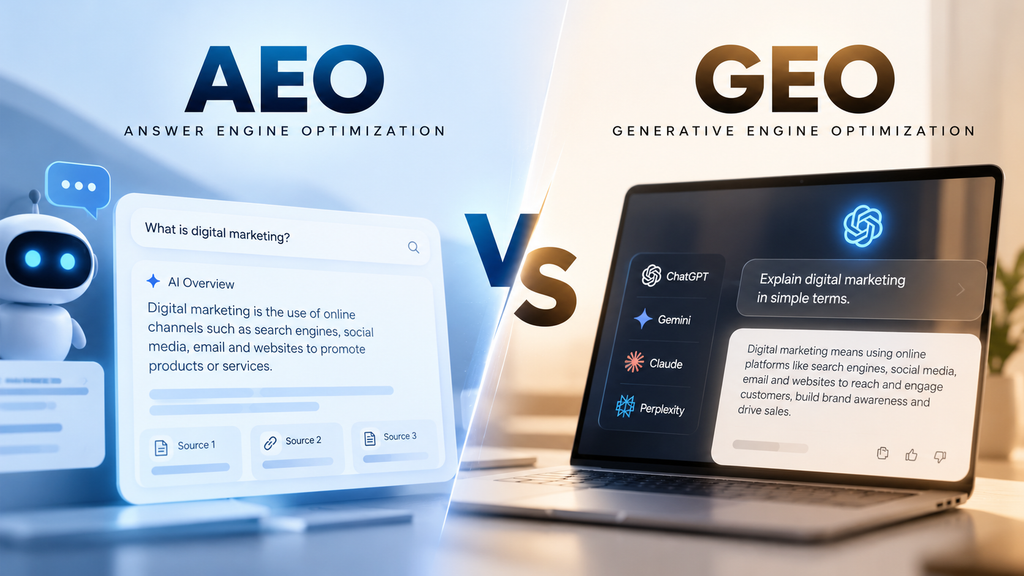
Search used to mean ten blue links. Now people ask ChatGPT, Perplexity, Gemini, or Google’s AI Overviews a question and get a finished answer. If your brand isn’t part of that answer, you’re invisible to a growing share of your audience.
That shift has produced two buzzwords: AEO and GEO. They’re often used interchangeably, which is confusing. Here’s what each one means, where they overlap, and how to approach both.
What is AEO (Answer Engine Optimization)?
AEO is the practice of structuring your content so that search engines and assistants can pull it out as a direct answer to a question.
The idea predates today’s AI chatbots. It grew out of featured snippets, “People Also Ask” boxes, and voice assistants like Alexa and Siri, where the system picks one answer and reads it out. AEO is about being that answer.
Typical AEO tactics:
- Writing clear, concise answers (40 to 60 words) directly under question-style headings
- Using FAQ sections and schema markup (FAQPage, HowTo, Article)
- Targeting conversational, long-tail questions (“How do I…”, “What is the best…”)
- Using lists, tables, and step-by-step formats that are easy to extract
- Keeping a strong technical foundation: fast pages, clean HTML, mobile-friendly design
The goal: be selected as the answer, whether in a snippet, a voice response, or an AI summary.
What is GEO (Generative Engine Optimization)?
GEO is the practice of increasing the chances that generative AI systems mention, cite, or recommend your brand or content in the responses they write. The term gained traction after a 2023 academic paper that tested which content changes made websites more likely to be surfaced in generative engine responses.
The difference is how the answer is produced. A snippet is extracted from one page. A generative answer is synthesized from many sources, and the model decides what to include, how to phrase it, and whom to credit. Your content might shape the answer without a single click to your site.
Typical GEO tactics:
- Building authority and trust signals: original research, expert authorship, and credible citations
- Including unique statistics, quotes, and data that models like to cite
- Earning mentions across the web, such as reviews, forums, news, Wikipedia, and industry publications, since models learn from and retrieve from these sources
- Writing with clear entities and context so the model understands who you are and what you’re known for
- Making content easy to retrieve: crawlable pages, no unnecessary blocking of AI crawlers, and clear structure
- Monitoring how AI tools describe your brand and correcting gaps or misinformation
The goal: be included and accurately represented in AI-generated responses.
AEO vs GEO: Side by Side
| AEO | GEO | |
|---|---|---|
| Core aim | Be the single, direct answer | Be cited or mentioned in synthesized answers |
| Main surfaces | Featured snippets, voice assistants, PAA boxes | ChatGPT, Perplexity, Gemini, AI Overviews, Claude |
| How content is used | Extracted, often verbatim | Summarized, blended, and paraphrased |
| Key levers | Structure, schema, concise answers | Authority, brand mentions, original data, retrievability |
| Success metric | Snippet or voice answer won | Citations, brand mentions, share of AI voice |
| Origin | Snippets and voice search era | LLM and generative search era |
Where They Overlap
Despite the different labels, AEO and GEO share most of their DNA:
- Helpful, accurate content wins in both.
- Clear structure (headings, direct answers, lists) helps machines parse your page.
- Credibility matters everywhere: authorship, sources, and reputation.
- Good SEO fundamentals remain the base. Pages that can’t be crawled or indexed rarely get surfaced by anyone.
Many practitioners treat AEO as a subset or predecessor of GEO. AEO asks, “Is my answer easy to lift?” GEO asks, “Does the AI know, trust, and recommend me?”
Which Should You Focus On?
You don’t have to choose, but your priorities may differ:
- Local businesses, publishers, and FAQ-heavy sites benefit from strong AEO: clean answers, schema, and voice-friendly content.
- SaaS, ecommerce, and brands competing on recommendations (“best CRM for startups”) should invest heavily in GEO, especially in third-party mentions and reviews.
- Everyone should keep SEO healthy, since it feeds both.
A Practical Starter Checklist
- Audit your questions. List the 20 to 50 questions your customers actually ask.
- Answer each directly, with a short answer first and depth after.
- Add structured data where it fits.
- Publish something original: a survey, benchmark, or case study others will want to cite.
- Build off-site presence through reviews, partnerships, PR, and community participation.
- Check your AI visibility. Ask the major AI tools about your category and see who gets named and what’s said about you.
- Update regularly. Fresh, maintained content tends to be trusted more.
The Bottom Line
AEO is about being the answer. GEO is about being part of the answer when AI writes it. The labels may keep evolving, but the underlying principle won’t: create content that’s genuinely useful, clearly structured, and backed by a reputation worth citing.
Do that, and you’ll be well positioned however people choose to search.